Regression Residuals
Download: RegressionResiduals_init.xlsx
Introduction
Residuals are an important set of statistics in regression analysis: they represent the variation of the variable that is not explained by the regression model. For a given data set they can be calculated as
where (read as “y-hat”) are the values predicted by the regression model for the values (ie, the “fitted” values). If the chosen regression model correctly represents the systematic variation of variable due to variable then the residuals represent the random variability in .
Residuals are used for a wide variety of purposes in regression analysis, including diagnosing whether we have in fact chosen the correct regression model. In this screencast we show how to calculate and interpret the standard deviation of the residuals, .
Learning Goals
- learn how to calculate residuals for a fitted regression model
- learn how to calculate and interpret the standard deviation of the residuals and its degrees of freedom
Tasks
- Use
SLOPEandINTERCEPTfunctions to calculate and , which are the least-squares estimates of regression model parameters and - Use those values to calculate fitted and values for the calibration data
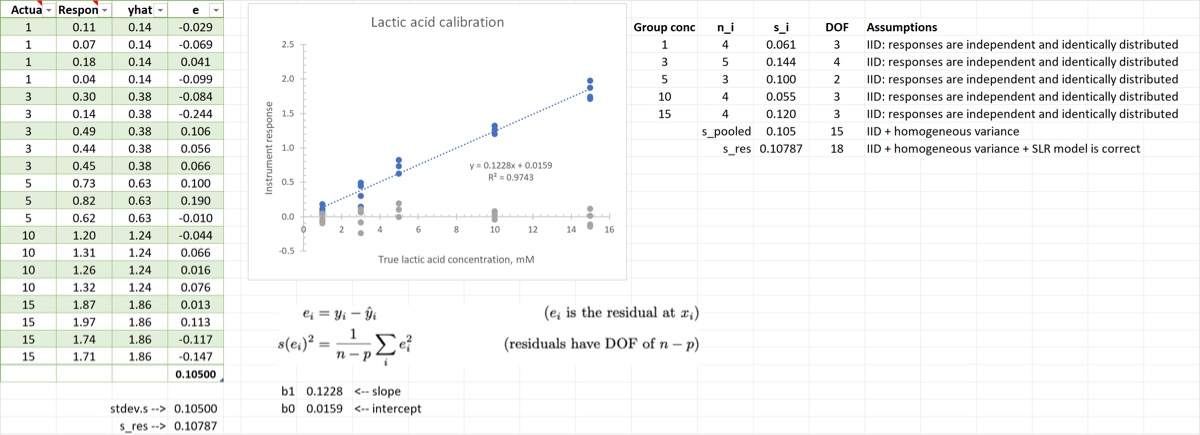
- Assuming that all measurements share the same standard deviation (ie assume homogeneous variance), calculate seven different estimates of the shared along with their DOFs. State the assumptions for each.
- Compare the standard deviation of the residuals as calculated with
STDEV.SandSTEYXand understand why they are different. Which is ?
When you are finished, your Excel worksheet should look like the image below.