Comparison of means
Download: MeanComparison_init.xlsx
Introduction
In this screencast we show how to construct a parametric confidence interval for the difference between the means or trimmed means of two samples. This allows us to make inferences about any underlying differences in the populations for the two samples.
Learning Goals
- learn how to use confidence intervals to test statistical significance
- learn how to use parametric confidence intervals to perform the 1-sample t-test, the 2-sample t-test, and the paired t-test
Tasks
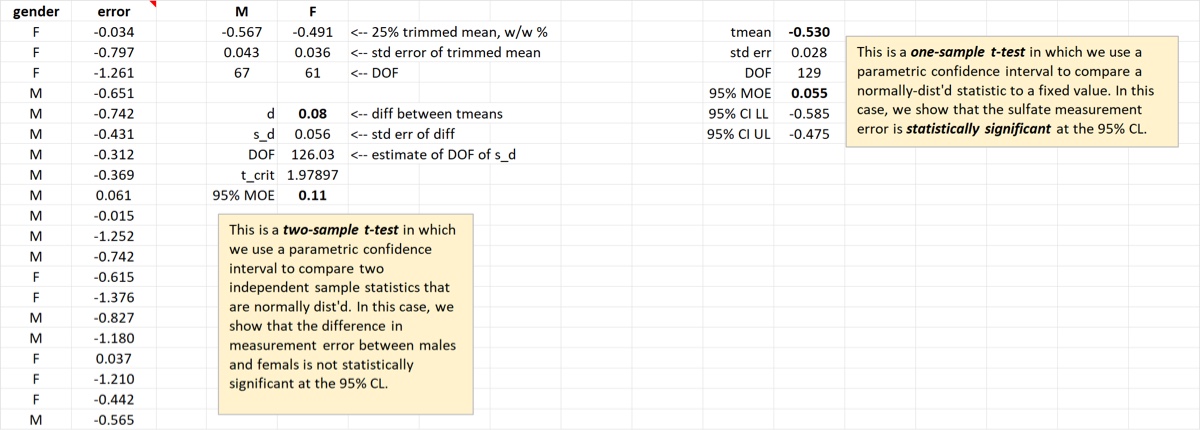
- Construct a confidence interval for the measurement bias and use the CI to make a statement about the magnitude and statistical significance of the bias (1-sample t-test)
- Construct a confidence interval comparing the accuracy of men and women (2-sample t-test)
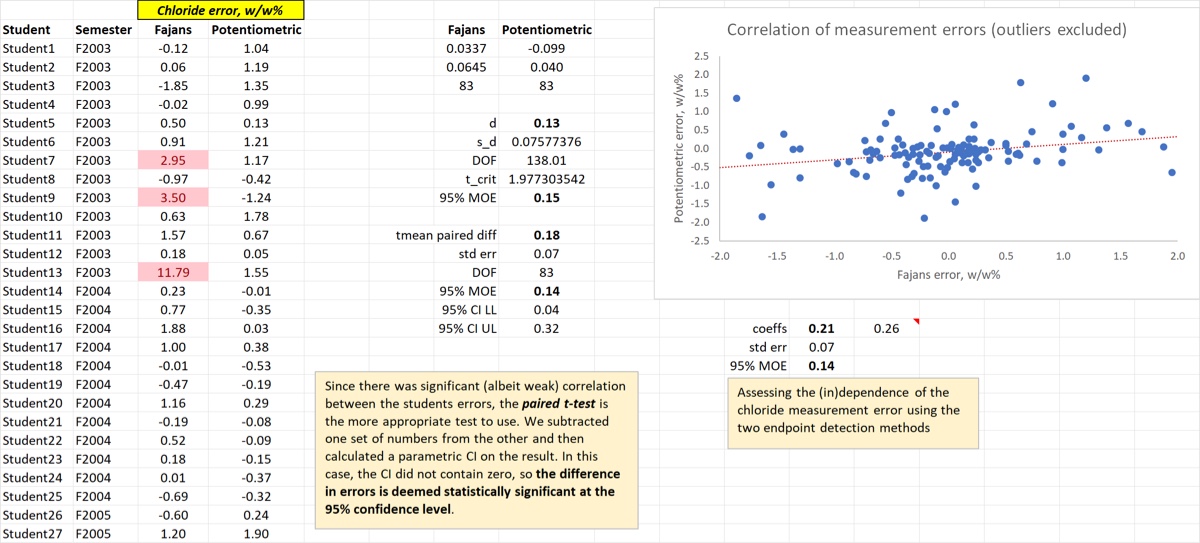
- Construct a CI comparing Fajans and potentiometric errors, assuming independence (2-sample t-test)
- Construct a CI comparing Fajans and potentiometric errors, assuming correlation between samples (paired t-test)
At the end of the screencast your two worksheets should look something like the images below.