Calibration with weighted LS regression
Introduction
Learning Goals
Tasks
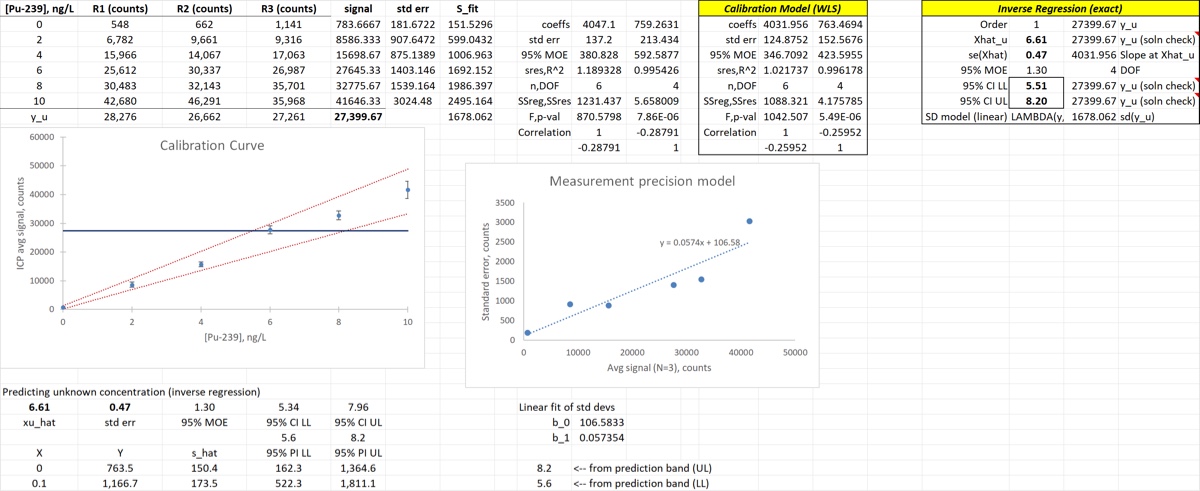
Twin goals: estimate the calibration function for heteroscedastic measurements, and perform inverse regression to estimate the concentration of an unknown. The data is adapted from Thompson & Lowthian, “Notes on Statistics and Data Quality for Analytical Chemists,” 2011.
- Unfold and plot the raw data to see the heteroscedasticity (then delete)
- Calculate the average and standard error (SEM) of the signals and examine, and plot with error bars
- Perform weighted LS regression using
WLS - Smooth the SEM values with a best fit line and perform weighted LS regression using
PolyLSand the smoothed standard deviations - Use
PolyPredto plot the prediction band using smoothed SEMs - Use weighted
PolyInvto predict , its standard error, and a 95% confidence interval (CI) for - Estimate the 95% CI from the prediction band
- Use the
Inverse Regressionprocedure (withSOLVER) to get the exact inverse regression
When you finish, your spreadsheet should resemble the image below.