ttestPower
Description
ttestPower performs a post-hoc power analysis of a one-sample or two-sample t-test. The function returns the statistical power that describes the probability of detecting a user-specified effect size.
Syntax
ttestPower(s_d, df, ES, [alpha = 0.05]) where
s_dis the standard deviation of the test statisticdfis the degrees of freedom of the std deviationESis the effect size that the user wants to be able to detectalphais the significance level of the hypothesis test
The function returns the probability that the procedure would detect the desired effect size.
Example
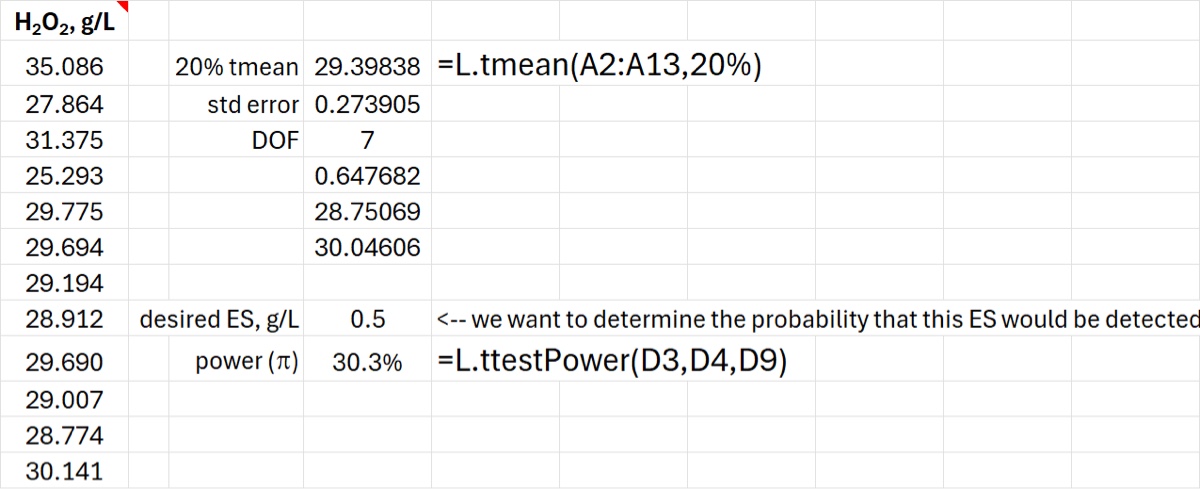
We will use the same data as with the ttestES documentation: 12 students measured the hydrogen peroxide levels in an OTC formulation that nominally contains 30 g/L of active ingredient. We want to be able to detect a deviation of 0.5 g/L from this amount; what is the probability of this level of deviation from nominal being detected using this measurement and statistical protocol? This function returns the answer (assuming all assumptions are valid): we have only a 30% chance of detecting that deviation.
Download: ttestPower.xlsx
Source Code
ttestPower = LAMBDA(
    s_d, // std deviation of the (non-studentized) test stat
    df, // degrees of freedom of s_d
    ES, // effect size to be detected by the t-test
    [alpha], // desired significance level (default 0.05)
    LET(
        alpha, IF(ISOMITTED(alpha), 0.05, alpha),
        tcrit, T.INV.2T(alpha, df),
        t_ES, ABS(ES) / s_d - tcrit,
        T.DIST(t_ES, df, TRUE)
    )
);