Series
Description
Series returns a sequence of numbers with the desired start value and step size, and an approximate stop value. Both this function and the companion Range function are convenient wrappers for SEQUENCE, meant to relieve you of having to do some mental math to get the sequence you want.
Series is useful for when you want to control the start and step values exactly; Range is useful when you want to specify the start and stop exactly, as well as the number of items.
Syntax
Series(start, stop, [step=1]) where
startis the value at the beginning of the sequencestopis the maximum of the last value of the sequence. That last value will never be larger thanstopand is guaranteed to be withinstepof it.stepis the step size
The sequence is returned as a column vector. The number of items is determined by the input values.
Example
The example compares the usage of Series and Range.
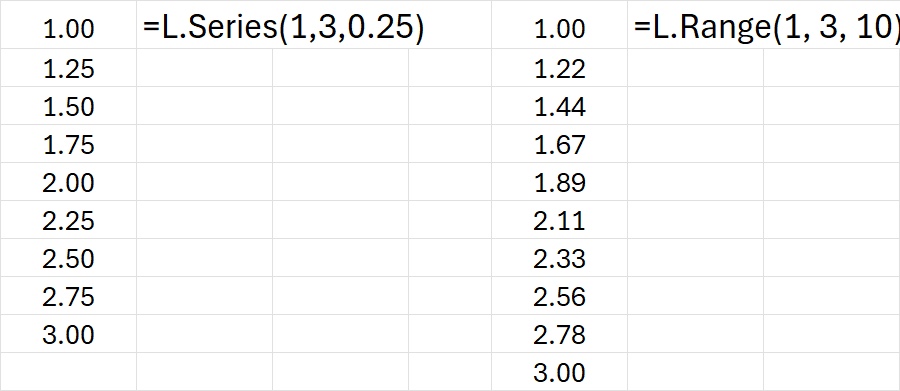
Download: SeriesRangeSequences.xlsx
Source Code
Series = LAMBDA(
    start, // first number in returned vector
    stop, // max value of final number in returned vector (not to be exceeded)
    [step], // optional step size; default is 1
    LET(
        step, IF(ISOMITTED(step), 1, step),
        length, FLOOR.MATH((stop - start) / step) + 1,
        SEQUENCE(length, 1, start, step)
    )
);